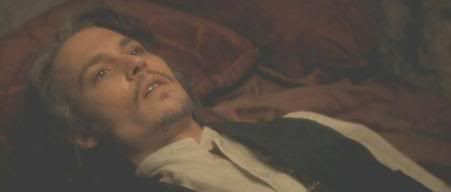
i was re-watching " From Hell " and (completely forgetting the first time i watched it) found it quite amusing that Johnny Depp's character, Inspector Frederick Abberline, frequents opium dens and drinks absinthe.
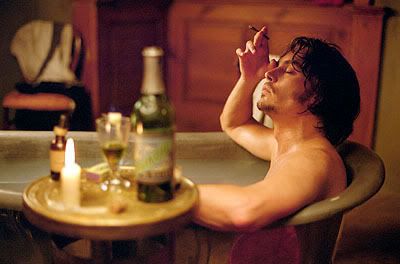
Effects of Absinthe:
" Absinthe has long been believed to be hallucinogenic. This belief got a contemporary boost in the 1970s when a scientific paper mistakenly reported thujone was related to THC, the active chemical in marijuana, which has hallucinogenic properties. Martin Paul Smith incorrectly argued that absinthe had narcotic effects due to the fermentation process in early 2008.
Ten years after his 19th century experiments with wormwood oil, the French Dr. Magnan studied 250 cases of alcoholism and claimed that those who drank absinthe were worse off than those drinking ordinary alcohol, and that they experienced rapid-onset hallucinations.
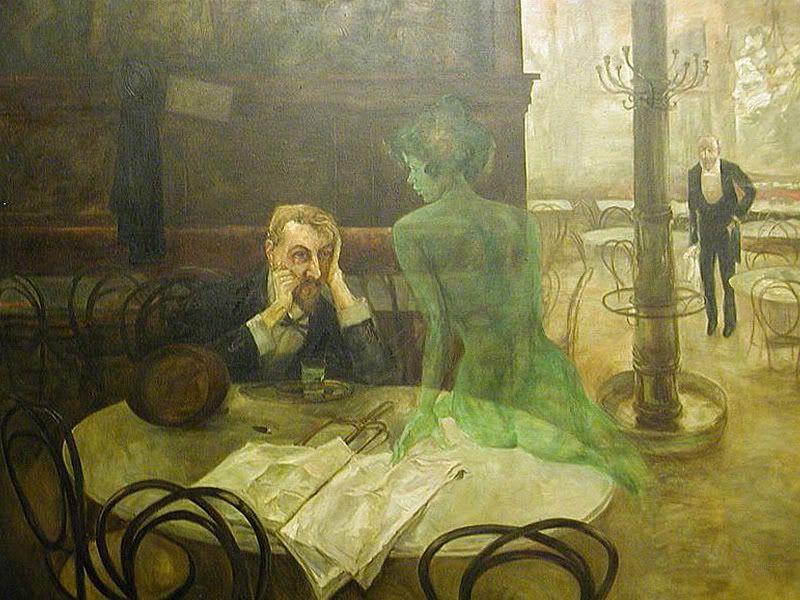
Such accounts by absinthe opponents were embraced by its most famous users, many of whom were bohemian artists or writers. In one of the best known accounts of absinthe drinking, Oscar Wilde described the feeling of having tulips on his legs after leaving a bar. Two famous painters who helped popularize the notion that absinthe had powerful psychoactive properties were Toulouse Lautrec and Vincent van Gogh (who suffered from mental instability throughout his life).
Today it is known that absinthe does not cause hallucinations, especially ones similar to those described in 19th century studies. Thujone, the supposed active chemical in absinthe, is a GABA antagonist and, while it can produce muscle spasms in large doses, there is no evidence that it causes hallucinations. It has been speculated that reports of hallucinogenic effects of absinthe may have been due to poisonous chemicals being added to cheaper versions of the drink in the 19th century, to give it a more vivid color.
However, the debate over whether absinthe produces effects on the human mind additional to those of alcohol has not been conclusively resolved. The effects of absinthe have been described by some artists as mind opening. The most commonly reported experience is a 'clear-headed' feeling of inebriation — a form of 'lucid drunkenness'. Some modern specialists, such as chemist, historian and absinthe distiller Ted Breaux, claim that alleged secondary effects of absinthe may be caused by the fact that some of the herbal compounds in the drink act as stimulants, while others act as sedatives, creating an overall lucid effect of awakening.
Long term effects of low absinthe consumption in humans remain unknown, although it is known that the herbs contained in absinthe have both painkilling and antiparasitic properties." - wikipedia.org
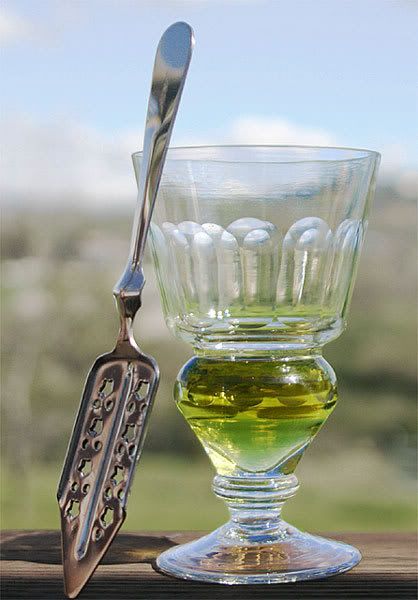
" Traditionally, absinthe is poured into a glass over which a specially designed slotted spoon is placed. A sugar cube is then deposited in the bowl of the spoon. Ice-cold water is poured or dripped over the sugar until the drink is diluted to a ratio between 3:1 and 5:1. During this process, the components that are not soluble in water, mainly those from anise, fennel, and star anise, come out of solution and cloud the drink. The resulting milky opalescence is called the louche (Fr. "opaque" or "shady", IPA). The addition of water is important, causing the herbs to "blossom" and bringing out many of the flavors originally overpowered by the anise." -wikipedia.org


No comments:
Post a Comment